Reference
Markers
The marker kinds and their arguments. The text comes from the package doc of docgen.
A marker has this form. Kinds const, gomod and var go inline in a sentence. Other kinds have the body on the lines between the two comments:
<!-- docgen:<kind> <arg>=<value> ... -->
<!-- /docgen:<kind> -->- Package paths are relative to the module.
pkg=sessionalso matchestransport/tcp/sessionwhen exactly one package path ends that way.- File paths, and
cmd=, are relative to the repository root.
Each box is the output of a docgen:docgen marker over a page of the test fixture.
Marker kinds§
docgen:output§
The output of a program, a command or an Example.
docgen:output cmd=<dir>
docgen:output exec="<command>"
docgen:output test=<pkg>.<ExampleName>
The arguments:
cmd=is the standard output ofgo runon the Go program in that directory, relative to the repository root, from its nearestgo.mod.exec=is the standard output of a shell command, run withsh -cin the repository root. A nonzero exit status is an error.test=is the expected output of an Example function, as written in its// Output:comment.go testfails when the real output differs, so the page cannot hold wrong output. Give the package and the function, such astest=machine.ExampleLamp.test=machine.Exampleis the Example of the package itself.
The output must be the same on each run, or check fails. A program or command with no output gives an empty block, and an Example with an empty // Output: comment is an error.
The output of an Example, with test=§
v2/machine/example_test.go
func ExampleLamp() {
    l, _ := machine.NewLamp(machine.Config{})
    _ = l.Start(0)
    fmt.Println(l.State() == machine.LampOn)
}
docs/machines/guide-output.md
Before
# Example

<!-- docgen:output test=machine.ExampleLamp -->
<!-- /docgen:output -->
After
# Example

<!-- docgen:output test=machine.ExampleLamp -->
```text
true
```
<!-- /docgen:output -->
Preview
Example
trueThe output of a program or a command, with cmd= or exec=§
v2/examples/hello/main.go
func main() {
    fmt.Println("hello from the fixture")
}
v2/go.mod
module github.com/USA-RedDragon/docgen/v2

go 1.24.0
docs/machines/guide-output-run.md
Before
<!-- docgen:output cmd=v2/examples/hello -->
<!-- /docgen:output -->

<!-- docgen:output exec="head -n 1 v2/go.mod" -->
<!-- /docgen:output -->
After
<!-- docgen:output cmd=v2/examples/hello -->
```text
hello from the fixture
```
<!-- /docgen:output -->

<!-- docgen:output exec="head -n 1 v2/go.mod" -->
```text
module github.com/USA-RedDragon/docgen/v2
```
<!-- /docgen:output -->
Preview
hello from the fixturemodule github.com/USA-RedDragon/docgen/v2docgen:code§
An excerpt of a file of the repository.
docgen:code file=<repo path> symbol=<Name>
docgen:code file=<repo path> region=<name>
docgen:code file=<repo path> lines=<a>-<b>
docgen:code file=<repo path>
The arguments:
symbol=in a Go file is one func, method (Type.Method), type, or const or var block, with no doc comment. An Example has no output comment.symbol=in a YAML file is the block of the key at a dotted path, such asjobs.testof a workflow. A last segmentkey[A:B]is the items of the list atkeyfrom the item with nameAto the item with nameB, andkey[A]is the one itemA.symbol=in a JSON or TOML file uses the same path form. In JSON the excerpt is"key": value. In TOML it is a key with its value, or a table[a.b]with its keys and sub-tables, andkey[A]is an item of the array of tables[[key]]. An item is found by itsnamekey, or by a number, its index from 0.\.is a dot in a key.symbol=in a C file is the#defineof Name or the definition of the function Name.region=is the lines between the linedocgen:region <name>and the next linedocgen:end. Each mark is the whole line apart from comment syntax. In a page, a mark in code or in a marker body is text. Other excerpts of the file leave out those two lines.lines=is those lines of the file. For a Go file the lines must hold whole declarations or statements. When the file changes, check and update fail. The error holds the new range when the old excerpt moved, and otherwise states that the range is out of date. A range past the last line is an error.- With none of these, the excerpt is the whole file.
raw=true, withsymbol=,lines=or the whole file, keeps the text of the file: doc comments, region marks and the output comment of an Example.symbol=packagein a Go file is then the package clause with its doc comment. Any other value is an error.
An excerpt with no text is an error.
On a scanned page, the excerpt is the text that update writes to that page. An excerpt of the page of its own marker is an error, and so are excerpts that do not settle in 8 passes.
A Go declaration, with symbol=§
v2/machine/machine.go
func (l *Lamp) Start(now time.Duration) error {
    if l.state == LampOn {
        return ErrBusy
    }
    if l.state == LampOff {
        l.state, l.until = LampOn, now+l.wait
    }
    return nil
}
docs/machines/guide-code.md
Before
# Start a lamp

<!-- docgen:code file=v2/machine/machine.go symbol=Lamp.Start -->
<!-- /docgen:code -->
After
# Start a lamp

<!-- docgen:code file=v2/machine/machine.go symbol=Lamp.Start -->
```go
func (l *Lamp) Start(now time.Duration) error {
    if l.state == LampOn {
        return ErrBusy
    }
    if l.state == LampOff {
        l.state, l.until = LampOn, now+l.wait
    }
    return nil
}
```
<!-- /docgen:code -->
Preview
Start a lamp
func (l *Lamp) Start(now time.Duration) error {
    if l.state == LampOn {
        return ErrBusy
    }
    if l.state == LampOff {
        l.state, l.until = LampOn, now+l.wait
    }
    return nil
}
A YAML key, with symbol=§
ci/workflow.yaml
jobs:
  test:
    env:
      GOFLAGS: -mod=readonly
    steps:
      - name: Get the code
        uses: actions/checkout@v6
      - name: Run the tests
        run: go test ./...
      - name: Check the docs
        run: docgen check
docs/machines/guide-code-yaml.md
Before
<!-- docgen:code file=ci/workflow.yaml symbol=jobs.test.env -->
<!-- /docgen:code -->

<!-- docgen:code file=ci/workflow.yaml symbol="jobs.test.steps[Get the code:Run the tests]" -->
<!-- /docgen:code -->

<!-- docgen:code file=ci/workflow.yaml symbol="jobs.test.steps[Check the docs]" -->
<!-- /docgen:code -->
After
<!-- docgen:code file=ci/workflow.yaml symbol=jobs.test.env -->
```yaml
env:
  GOFLAGS: -mod=readonly
```
<!-- /docgen:code -->

<!-- docgen:code file=ci/workflow.yaml symbol="jobs.test.steps[Get the code:Run the tests]" -->
```yaml
- name: Get the code
  uses: actions/checkout@v6
- name: Run the tests
  run: go test ./...
```
<!-- /docgen:code -->

<!-- docgen:code file=ci/workflow.yaml symbol="jobs.test.steps[Check the docs]" -->
```yaml
- name: Check the docs
  run: docgen check
```
<!-- /docgen:code -->
Preview
env:
  GOFLAGS: -mod=readonly
- name: Get the code
uses: actions/checkout@v6
- name: Run the tests
run: go test ./...- name: Check the docs
run: docgen checkA JSON member, with symbol=§
config/app.json
{
  "server": {
    "port": 8080,
    "hosts": ["a.example", "b.example"]
  },
  "jobs": [
    {"name": "build", "run": "go build ./..."},
    {"name": "test", "run": "go test ./..."},
    {"name": "docs", "run": "docgen check"}
  ]
}
docs/machines/guide-code-json.md
Before
<!-- docgen:code file=config/app.json symbol=server.port -->
<!-- /docgen:code -->

<!-- docgen:code file=config/app.json symbol="jobs[build:test]" -->
<!-- /docgen:code -->

<!-- docgen:code file=config/app.json symbol=jobs[2] -->
<!-- /docgen:code -->
After
<!-- docgen:code file=config/app.json symbol=server.port -->
```json
"port": 8080
```
<!-- /docgen:code -->

<!-- docgen:code file=config/app.json symbol="jobs[build:test]" -->
```json
{"name": "build", "run": "go build ./..."},
{"name": "test", "run": "go test ./..."}
```
<!-- /docgen:code -->

<!-- docgen:code file=config/app.json symbol=jobs[2] -->
```json
{"name": "docs", "run": "docgen check"}
```
<!-- /docgen:code -->
Preview
"port": 8080{"name": "build", "run": "go build ./..."},
{"name": "test", "run": "go test ./..."}{"name": "docs", "run": "docgen check"}A TOML table or key, with symbol=§
config/app.toml
[server]
port = 8080 # the default port
hosts = [
  "a.example",
  "b.example",
]

[[jobs]]
name = "build"
run = "go build ./..."

[[jobs]]
name = "test"
run = """
go vet ./...
go test ./..."""
docs/machines/guide-code-toml.md
Before
<!-- docgen:code file=config/app.toml symbol=server -->
<!-- /docgen:code -->

<!-- docgen:code file=config/app.toml symbol=server.hosts -->
<!-- /docgen:code -->

<!-- docgen:code file=config/app.toml symbol=jobs[test] -->
<!-- /docgen:code -->
After
<!-- docgen:code file=config/app.toml symbol=server -->
```toml
[server]
port = 8080 # the default port
hosts = [
  "a.example",
  "b.example",
]
```
<!-- /docgen:code -->

<!-- docgen:code file=config/app.toml symbol=server.hosts -->
```toml
hosts = [
  "a.example",
  "b.example",
]
```
<!-- /docgen:code -->

<!-- docgen:code file=config/app.toml symbol=jobs[test] -->
```toml
[[jobs]]
name = "test"
run = """
go vet ./...
go test ./..."""
```
<!-- /docgen:code -->
Preview
[server]
port = 8080 # the default port
hosts = [
  "a.example",
  "b.example",
]
hosts = [
"a.example",
"b.example",
][[jobs]]
name = "test"
run = """
go vet ./...
go test ./..."""A C function or #define, with symbol=§
native/lamp.c
#define LAMP_MAX_TRIES 3

static int tries;

int lamp_start(int count)
{
    if (count > LAMP_MAX_TRIES) {
        return -1;
    }
    tries = count;
    return 0;
}
docs/machines/guide-code-c.md
Before
<!-- docgen:code file=native/lamp.c symbol=LAMP_MAX_TRIES -->
<!-- /docgen:code -->

<!-- docgen:code file=native/lamp.c symbol=lamp_start -->
<!-- /docgen:code -->
After
<!-- docgen:code file=native/lamp.c symbol=LAMP_MAX_TRIES -->
```c
#define LAMP_MAX_TRIES 3
```
<!-- /docgen:code -->

<!-- docgen:code file=native/lamp.c symbol=lamp_start -->
```c
int lamp_start(int count)
{
    if (count > LAMP_MAX_TRIES) {
        return -1;
    }
    tries = count;
    return 0;
}
```
<!-- /docgen:code -->
Preview
#define LAMP_MAX_TRIES 3int lamp_start(int count)
{
if (count > LAMP_MAX_TRIES) {
return -1;
}
tries = count;
return 0;
}A region, a line range or a whole file§
scripts/build.sh
#!/bin/sh
set -eu
# docgen:region setup
go mod download
go build ./...
# docgen:end
go test ./...
docs/machines/guide-code-file.md
Before
<!-- docgen:code file=scripts/build.sh region=setup -->
<!-- /docgen:code -->

<!-- docgen:code file=scripts/build.sh lines=1-2 -->
<!-- /docgen:code -->

<!-- docgen:code file=scripts/build.sh -->
<!-- /docgen:code -->
After
<!-- docgen:code file=scripts/build.sh region=setup -->
```sh
go mod download
go build ./...
```
<!-- /docgen:code -->

<!-- docgen:code file=scripts/build.sh lines=1-2 -->
```sh
#!/bin/sh
set -eu
```
<!-- /docgen:code -->

<!-- docgen:code file=scripts/build.sh -->
```sh
#!/bin/sh
set -eu
go mod download
go build ./...
go test ./...
```
<!-- /docgen:code -->
Preview
go mod download
go build ./...
#!/bin/sh
set -eu#!/bin/sh
set -eu
go mod download
go build ./...
go test ./...An excerpt with its comments and marks, with raw=true§
v2/machine/machine.go
// Package machine is a small state machine for the docgen tests.
//
// # Rates
//
// A Lamp blinks at these rates:
// - slow, every [DefaultWait]
// - fast, every period
//
// # Other
//
// Not copied.
package machine// Start turns the Lamp on. It returns ErrBusy while the Lamp is on.
func (l *Lamp) Start(now time.Duration) error {
if l.state == LampOn {
return ErrBusy
}
if l.state == LampOff {
l.state, l.until = LampOn, now+l.wait
}
return nil
}scripts/build.sh
#!/bin/sh
set -eu
# docgen:region setup
go mod download
go build ./...
# docgen:end
go test ./...docs/machines/guide-code-raw.md
Before
# Keep the comments
<!-- docgen:code file=v2/machine/machine.go symbol=Lamp.Start raw=true -->
<!-- /docgen:code -->
<!-- docgen:code file=v2/machine/machine.go symbol=package raw=true -->
<!-- /docgen:code -->
<!-- docgen:code file=scripts/build.sh raw=true -->
<!-- /docgen:code -->After
# Keep the comments
<!-- docgen:code file=v2/machine/machine.go symbol=Lamp.Start raw=true -->
```go
// Start turns the Lamp on. It returns ErrBusy while the Lamp is on.
func (l *Lamp) Start(now time.Duration) error {
if l.state == LampOn {
return ErrBusy
}
if l.state == LampOff {
l.state, l.until = LampOn, now+l.wait
}
return nil
}
```
<!-- /docgen:code -->
<!-- docgen:code file=v2/machine/machine.go symbol=package raw=true -->
```go
// Package machine is a small state machine for the docgen tests.
//
// # Rates
//
// A Lamp blinks at these rates:
//   - slow, every [DefaultWait]
//   - fast, every period
//
// # Other
//
// Not copied.
package machine
```
<!-- /docgen:code -->
<!-- docgen:code file=scripts/build.sh raw=true -->
```sh
#!/bin/sh
set -eu
# docgen:region setup
go mod download
go build ./...
# docgen:end
go test ./...
```
<!-- /docgen:code -->Preview
Keep the comments
// Start turns the Lamp on. It returns ErrBusy while the Lamp is on.
func (l *Lamp) Start(now time.Duration) error {
    if l.state == LampOn {
        return ErrBusy
    }
    if l.state == LampOff {
        l.state, l.until = LampOn, now+l.wait
    }
    return nil
}// Package machine is a small state machine for the docgen tests.
//
// # Rates
//
// A Lamp blinks at these rates:
// - slow, every [DefaultWait]
// - fast, every period
//
// # Other
//
// Not copied.
package machine#!/bin/sh
set -eu
# docgen:region setup
go mod download
go build ./...
# docgen:end
go test ./...docgen:config§
A table of the fields of a struct type, with the columns Field, Type, Default and Description.
docgen:config pkg=<path> type=<Config> [print=<go|raw|name|verb>]type= is a struct type of the package, exported or not. It can also be an alias or a defined type of a struct type, or of an instance of a generic struct type, such as type Small = Gen[int].
The rows:
- Each exported field is one row, in source order.
- An embedded field with an exported type name, such as
Timingor*url.URL, is one row. The type name is the field name. - An unexported field has no row.
- An embedded field with an unexported type name has no row.
- The fields of an embedded struct have no rows.
The Field column holds the field name. The Type column holds the field type as it is in Go source in the package of the marker:
- A type of another package has the package name, such as
time.Durationormap[string]*url.URL. - Pointers, slices, maps, channels, funcs, struct types with their tags and instances of generic types, such as
q.G[string], are as in Go source. - An alias is the alias name.
- A cgo type has the prefix
C., such asC.int.
The Description column holds the doc comment of the field:
- With no doc comment, it holds the trailing comment. With neither, it is empty.
- Each name in one declaration, such as
A, B int // The limits., has that comment. - For an alias or a defined type of a struct, the comments come from the declaration of that struct, also in another package.
- Line breaks and blank lines become spaces.
- A
|becomes\|. Other text, such as HTML, backticks and doc links, stays as written, so Markdown renders it.
The Default column holds each default of the field as written in the code, with its value in parentheses. Two or more defaults are joined with "or", in the order of file names and lines. A default written the same way twice is there once. A field with no default has one of these:
- "not machine-readable; see the description", when the field doc has a phrase from the list below.
- "zero value", when it does not.
The phrases match in any case and across a line break: 0 means, nil means, zero means, empty means, a zero <word> means, an empty <word> means, defaults to and by default. Other text, such as "Zero value means" or "The default is", gives "zero value".
docgen finds a default in the files of the package of pkg=. Files that end in _test.go, and the code of other packages, do not count. For a default that is set in another package, use pkg= of that package and an alias of the type there, such as type Config = server.Config.
A default is the value V of an assignment y = V in this form:
if x == 0 {
y = V
}x and y are copies of the same field. A copy is one of these:
- The field itself, such as
c.Wait, for any value of the struct type. - A variable or field that gets a copy:
wait := c.Wait,wait = c.Waitorvar wait = c.Wait. - A field that gets a copy in a composite literal, such as
waitinLamp{wait: c.Wait}. Thenl.waitis a copy for anyLampl. - A parameter of a function or method of the package that gets a copy as its argument, such as
noffunc use(n int)inuse(c.Wait).
The forms of the test:
- The condition of an
if, or a case of aswitchwith no tag. x == Zorx <= Z, where Z is0,0.0,"",nil, or a constant with the value 0 or "".- The
ifcan have an init statement:if x := c.Wait; x == 0. - The assignment can be in a nested
ifor block of the body.
These do not count:
- The tests
0 == x,x < 1,!x,x == false,len(x) == 0andx == 0 && y. - A
switch xwith a tag, and theelseof anif. - An assignment with
:=or+=, with two or more targets, or in afororrangeloop or a func literal.
print= sets the text of the value in parentheses, with the same choices as docgen:const. With no print=, the print setting applies. Its default is go.
go: the value asfmt.Sprintprints it, with the String, Error, Format and GoString methods of its type:DefaultWait(250ms). A literal, such as3, has no value, unless its type has one of these methods:80(port-80).raw: the underlying value, with no method:DefaultWait(250000000). A literal has no value.name: the name of the one constant of the type with the value, as fordocgen:const:LevelLow + 1(LevelHigh), or60 * time.Second(time.Minute). A literal has no value, and neither does a value with no such constant.- A fmt verb, such as
%x: the value with that verb, also of a literal:DefaultColor(ffaa00).
A default that is not a constant, such as hold or new(int), has no value with any print=. A value with the same text as its default, such as -1, has no parentheses. A value of a type with one of these methods comes from one go test run of the package, as for docgen:const.
These are errors:
pkg=with no package, ortype=that is not a type of the package.- A type that is not a struct, a generic type, or a struct with no row.
- An empty
print=, or a value that is notgo,raw,nameor one fmt verb. - A verb that a default cannot use, such as
%dfor a string. print=namewhen two constants of the type have the value.
Defaults as Go prints them§
v2/machine/machine.go
type Config struct {
// Wait is how long the Lamp stays on. 0 means DefaultWait.
Wait time.Duration
// Tries is the number of blinks. 0 means 1, and it is at most MaxTries.
Tries int
// Name is a label.
Name string
}func NewLamp(cfg Config) (*Lamp, error) {
if cfg.Tries > MaxTries {
return nil, &docgen.ConfigError{Field: "Tries"}
}
l := &Lamp{wait: cfg.Wait, tries: cfg.Tries}
if l.wait == 0 {
l.wait = DefaultWait
}
if cfg.Tries == 0 {
l.tries = 1
}
return l, nil
}docs/machines/guide-config.md
Before
# Settings
<!-- docgen:config pkg=machine type=Config -->
<!-- /docgen:config -->After
# Settings
<!-- docgen:config pkg=machine type=Config -->
| Field | Type | Default | Description |
|---|---|---|---|
| `Wait` | `time.Duration` | `DefaultWait` (250ms) | Wait is how long the Lamp stays on. 0 means DefaultWait. |
| `Tries` | `int` | `1` | Tries is the number of blinks. 0 means 1, and it is at most MaxTries. |
| `Name` | `string` | zero value | Name is a label. |
<!-- /docgen:config -->Preview
Settings
| Field | Type | Default | Description |
|---|---|---|---|
Wait |
time.Duration |
DefaultWait (250ms) |
Wait is how long the Lamp stays on. 0 means DefaultWait. |
Tries |
int |
1 |
Tries is the number of blinks. 0 means 1, and it is at most MaxTries. |
Name |
string |
zero value | Name is a label. |
Underlying values, with print=raw§
v2/machine/machine.go
const DefaultWait = 250 * time.Millisecondtype Config struct {
// Wait is how long the Lamp stays on. 0 means DefaultWait.
Wait time.Duration
// Tries is the number of blinks. 0 means 1, and it is at most MaxTries.
Tries int
// Name is a label.
Name string
}func NewLamp(cfg Config) (*Lamp, error) {
if cfg.Tries > MaxTries {
return nil, &docgen.ConfigError{Field: "Tries"}
}
l := &Lamp{wait: cfg.Wait, tries: cfg.Tries}
if l.wait == 0 {
l.wait = DefaultWait
}
if cfg.Tries == 0 {
l.tries = 1
}
return l, nil
}docs/machines/guide-config-print.md
Before
<!-- docgen:config pkg=machine type=Config print=raw -->
<!-- /docgen:config -->After
<!-- docgen:config pkg=machine type=Config print=raw -->
| Field | Type | Default | Description |
|---|---|---|---|
| `Wait` | `time.Duration` | `DefaultWait` (250000000) | Wait is how long the Lamp stays on. 0 means DefaultWait. |
| `Tries` | `int` | `1` | Tries is the number of blinks. 0 means 1, and it is at most MaxTries. |
| `Name` | `string` | zero value | Name is a label. |
<!-- /docgen:config -->Preview
| Field | Type | Default | Description |
|---|---|---|---|
Wait |
time.Duration |
DefaultWait (250000000) |
Wait is how long the Lamp stays on. 0 means DefaultWait. |
Tries |
int |
1 |
Tries is the number of blinks. 0 means 1, and it is at most MaxTries. |
Name |
string |
zero value | Name is a label. |
Constant names, with print=name§
v2/dimmer/dimmer.go
const (
// LevelOff gives no light.
LevelOff Level = iota
// LevelLow gives some light.
LevelLow
// LevelHigh gives full light.
LevelHigh
)type Look struct {
// Level is the brightness at start.
Level Level
// Color is an RGB color.
Color uint32
}func NewLook(l Look) Look {
if l.Level == LevelOff {
l.Level = LevelLow + 1
}
if l.Color == 0 {
l.Color = DefaultColor
}
return l
}docs/dimmer/config-name.md
Before
<!-- docgen:config pkg=dimmer type=Look print=name -->
<!-- /docgen:config -->After
<!-- docgen:config pkg=dimmer type=Look print=name -->
| Field | Type | Default | Description |
|---|---|---|---|
| `Level` | `Level` | `LevelLow + 1` (LevelHigh) | Level is the brightness at start. |
| `Color` | `uint32` | `DefaultColor` | Color is an RGB color. |
<!-- /docgen:config -->Preview
| Field | Type | Default | Description |
|---|---|---|---|
Level |
Level |
LevelLow + 1 (LevelHigh) |
Level is the brightness at start. |
Color |
uint32 |
DefaultColor |
Color is an RGB color. |
Values with a fmt verb, such as print=%x§
v2/dimmer/dimmer.go
const DefaultColor = 0xffaa00type Look struct {
// Level is the brightness at start.
Level Level
// Color is an RGB color.
Color uint32
}func NewLook(l Look) Look {
if l.Level == LevelOff {
l.Level = LevelLow + 1
}
if l.Color == 0 {
l.Color = DefaultColor
}
return l
}docs/dimmer/config-verb.md
Before
<!-- docgen:config pkg=dimmer type=Look print=%x -->
<!-- /docgen:config -->After
<!-- docgen:config pkg=dimmer type=Look print=%x -->
| Field | Type | Default | Description |
|---|---|---|---|
| `Level` | `Level` | `LevelLow + 1` (2) | Level is the brightness at start. |
| `Color` | `uint32` | `DefaultColor` (ffaa00) | Color is an RGB color. |
<!-- /docgen:config -->Preview
| Field | Type | Default | Description |
|---|---|---|---|
Level |
Level |
LevelLow + 1 (2) |
Level is the brightness at start. |
Color |
uint32 |
DefaultColor (ffaa00) |
Color is an RGB color. |
A field whose default is not machine-readable§
v2/dimmer/dimmer.go
type Steps struct {
// Step is the change of one press. 0 means 1.
Step int
}func NewSteps(s Steps) Steps {
if s.Step < 1 {
s.Step = 1
}
return s
}docs/dimmer/config-text.md
Before
<!-- docgen:config pkg=dimmer type=Steps -->
<!-- /docgen:config -->After
<!-- docgen:config pkg=dimmer type=Steps -->
| Field | Type | Default | Description |
|---|---|---|---|
| `Step` | `int` | not machine-readable; see the description | Step is the change of one press. 0 means 1. |
<!-- /docgen:config -->Preview
| Field | Type | Default | Description |
|---|---|---|---|
Step |
int |
not machine-readable; see the description | Step is the change of one press. 0 means 1. |
A field with no default§
v2/dimmer/dimmer.go
type Tag struct {
// Name is a label next to the Dimmer.
Name string
}docs/dimmer/config-zero.md
Before
<!-- docgen:config pkg=dimmer type=Tag -->
<!-- /docgen:config -->After
<!-- docgen:config pkg=dimmer type=Tag -->
| Field | Type | Default | Description |
|---|---|---|---|
| `Name` | `string` | zero value | Name is a label next to the Dimmer. |
<!-- /docgen:config -->Preview
| Field | Type | Default | Description |
|---|---|---|---|
Name |
string |
zero value | Name is a label next to the Dimmer. |
Rows of embedded fields§
v2/dimmer/dimmer.go
type Timing struct {
// Fade is the time of a change of level.
Fade time.Duration
}type counts struct {
// Presses is the number of presses.
Presses int
}type Setup struct {
// Timing holds the times.
Timing
counts
// Look is the light at start.
Look Look
}docs/dimmer/config-embedded.md
Before
<!-- docgen:config pkg=dimmer type=Setup -->
<!-- /docgen:config -->After
<!-- docgen:config pkg=dimmer type=Setup -->
| Field | Type | Default | Description |
|---|---|---|---|
| `Timing` | `Timing` | zero value | Timing holds the times. |
| `Look` | `Look` | zero value | Look is the light at start. |
<!-- /docgen:config -->Preview
| Field | Type | Default | Description |
|---|---|---|---|
Timing |
Timing |
zero value | Timing holds the times. |
Look |
Look |
zero value | Look is the light at start. |
Field types from other packages§
v2/dimmer/dimmer.go
type Group struct {
// Main is the first lamp.
Main *machine.Lamp
// Spares are the other lamps.
Spares []machine.Lamp
// States holds the state of each lamp by name.
States map[string]machine.LampState
}docs/dimmer/config-types.md
Before
<!-- docgen:config pkg=dimmer type=Group -->
<!-- /docgen:config -->After
<!-- docgen:config pkg=dimmer type=Group -->
| Field | Type | Default | Description |
|---|---|---|---|
| `Main` | `*machine.Lamp` | zero value | Main is the first lamp. |
| `Spares` | `[]machine.Lamp` | zero value | Spares are the other lamps. |
| `States` | `map[string]machine.LampState` | zero value | States holds the state of each lamp by name. |
<!-- /docgen:config -->Preview
| Field | Type | Default | Description |
|---|---|---|---|
Main |
*machine.Lamp |
zero value | Main is the first lamp. |
Spares |
[]machine.Lamp |
zero value | Spares are the other lamps. |
States |
map[string]machine.LampState |
zero value | States holds the state of each lamp by name. |
A description from a trailing comment§
v2/dimmer/dimmer.go
type Range struct {
Min Level // Min is the lowest level.
// Max is the highest level.
Max Level // This comment is not in the table.
}docs/dimmer/config-trailing.md
Before
<!-- docgen:config pkg=dimmer type=Range -->
<!-- /docgen:config -->After
<!-- docgen:config pkg=dimmer type=Range -->
| Field | Type | Default | Description |
|---|---|---|---|
| `Min` | `Level` | zero value | Min is the lowest level. |
| `Max` | `Level` | zero value | Max is the highest level. |
<!-- /docgen:config -->Preview
| Field | Type | Default | Description |
|---|---|---|---|
Min |
Level |
zero value | Min is the lowest level. |
Max |
Level |
zero value | Max is the highest level. |
docgen:configulator§
The reference table of a config type of configulator: each key, with its type, default, environment variable, flag and description.
docgen:configulator pkg=<path> type=<Config> [env=<prefix>] [envsep=<separator>] [flagsep=<separator>]config.go
type Server struct {
Port int `name:"port" default:"8080" description:"port of the server"`
}type Config struct {
Name string `name:"name" default:"lamp" description:"name of the program"`
Server Server `name:"server"`
}docs/guide-configulator.md
Before
<!-- docgen:configulator pkg=. type=Config env=APP_ envsep=__ flagsep=- -->
<!-- /docgen:configulator -->After
<!-- docgen:configulator pkg=. type=Config env=APP_ envsep=__ flagsep=- -->
| Key | Type | Default | Environment | Flag | Description |
|---------------|---------|---------|--------------------|-----------------|---------------------|
| `name` | string | `lamp` | `APP_NAME` | `--name` | name of the program |
| `server.port` | integer | `8080` | `APP_SERVER__PORT` | `--server-port` | port of the server |
<!-- /docgen:configulator -->Preview
| Key | Type | Default | Environment | Flag | Description |
|---|---|---|---|---|---|
name |
string | lamp |
APP_NAME |
--name |
name of the program |
server.port |
integer | 8080 |
APP_SERVER__PORT |
--server-port |
port of the server |
docgen:const§
The value of a constant, or of a package-level var with a constant initial value, exported or not. It goes inline in a sentence.
docgen:const pkg=<path> name=<Name> [print=<go|raw|name|verb>] [code=false]print= sets how the value prints:
print=gois the default. The value prints asfmt.Sprintprints it, with the String, Error, Format and GoString methods of its type, so250 * time.Millisecondis250ms, strings have no quotes and1e6is1e+06.print=rawis the underlying value with no method, and runs no code:4001for a port with a String method,1for an enum, and1500000000for atime.Durationof 1.5s.print=nameis the name of the one constant of the type with the value, from the package of the marker and then the package of the type. A constant of the package of the type is exported and has the package name, as in Go source:time.Minutefor60 * time.Second.print=%d, or any other fmt verb, is the value with that verb.
An empty value prints as "", and line endings in a value print as spaces. A verb that the value cannot use is an error. An integer too large for its default type prints its exact value. A type with a print method runs in one go test for each package, so the tests of that package must compile.
With code=false, the value has no backticks: 250ms in place of 250ms. Any other value of code= is an error.
A value as Go prints it§
v2/machine/machine.go
const DefaultWait = 250 * time.Milliseconddocs/machines/guide-const.md
Before
The default wait is <!-- docgen:const pkg=machine name=DefaultWait --><!-- /docgen:const -->.After
The default wait is <!-- docgen:const pkg=machine name=DefaultWait -->`250ms`<!-- /docgen:const -->.Preview
The default wait is 250ms.
A value in another form, with print=§
v2/machine/port.go
package machine
import "fmt"
// Port is a network port.
type Port uint16
// String returns the port as text.
func (p Port) String() string { return fmt.Sprintf("port %d", uint16(p)) }
// PortWeb is the port of the web server.
const PortWeb Port = 8080
// Listen is the port of a new Lamp.
var Listen = PortWebdocs/machines/guide-const-print.md
Before
- Default: <!-- docgen:const pkg=machine name=Listen --><!-- /docgen:const -->
- `go`: <!-- docgen:const pkg=machine name=Listen print=go --><!-- /docgen:const -->
- `raw`: <!-- docgen:const pkg=machine name=Listen print=raw --><!-- /docgen:const -->
- `name`: <!-- docgen:const pkg=machine name=Listen print=name --><!-- /docgen:const -->
- `%06d`: <!-- docgen:const pkg=machine name=Listen print=%06d --><!-- /docgen:const -->After
- Default: <!-- docgen:const pkg=machine name=Listen -->`port 8080`<!-- /docgen:const -->
- `go`: <!-- docgen:const pkg=machine name=Listen print=go -->`port 8080`<!-- /docgen:const -->
- `raw`: <!-- docgen:const pkg=machine name=Listen print=raw -->`8080`<!-- /docgen:const -->
- `name`: <!-- docgen:const pkg=machine name=Listen print=name -->`PortWeb`<!-- /docgen:const -->
- `%06d`: <!-- docgen:const pkg=machine name=Listen print=%06d -->`008080`<!-- /docgen:const -->Preview
- Default:
port 8080 go:port 8080raw:8080name:PortWeb%06d:008080
A value with no backticks, with code=false§
v2/machine/machine.go
const DefaultWait = 250 * time.Milliseconddocs/machines/guide-const-code.md
Before
The default wait is <!-- docgen:const pkg=machine name=DefaultWait code=false --><!-- /docgen:const -->.After
The default wait is <!-- docgen:const pkg=machine name=DefaultWait code=false -->250ms<!-- /docgen:const -->.Preview
The default wait is 250ms.
docgen:errors§
A table of the errors named in the doc comments of the constructors and methods of a type. Names resolve in the package, the module packages that it imports and the root package of the module. Consts and vars of any error type count.
docgen:errors pkg=<path> type=<Type>v2/machine/machine.go
var (
// ErrBusy is returned by Start while the Lamp is on.
ErrBusy = errors.New("machine: busy")
// ErrOff is returned by Stop while the Lamp is off.
ErrOff = errors.New("machine: off")
)// NewLamp returns a Lamp. It returns a *docgen.ConfigError for a Tries
// above MaxTries.
func NewLamp(cfg Config) (*Lamp, error) {
if cfg.Tries > MaxTries {
return nil, &docgen.ConfigError{Field: "Tries"}
}
l := &Lamp{wait: cfg.Wait, tries: cfg.Tries}
if l.wait == 0 {
l.wait = DefaultWait
}
if cfg.Tries == 0 {
l.tries = 1
}
return l, nil
}// Start turns the Lamp on. It returns ErrBusy while the Lamp is on.
func (l *Lamp) Start(now time.Duration) error {
if l.state == LampOn {
return ErrBusy
}
if l.state == LampOff {
l.state, l.until = LampOn, now+l.wait
}
return nil
}// Stop turns the Lamp off. It returns ErrOff while the Lamp is off.
func (l *Lamp) Stop() error {
if l.state != LampOn {
return ErrOff
}
l.off()
return nil
}v2/doc.go
// Package docgen is the fixture root package of the docgen tests.
package docgen
// ConfigError is the error of a constructor for a field with a value out
// of range.
type ConfigError struct{ Field string }
func (e *ConfigError) Error() string { return "bad " + e.Field }docs/machines/guide-errors.md
Before
# Errors
<!-- docgen:errors pkg=machine type=Lamp -->
<!-- /docgen:errors -->After
# Errors
<!-- docgen:errors pkg=machine type=Lamp -->
| Error | Returned by | Meaning |
|---|---|---|
| [`docgen.ConfigError`](https://pkg.go.dev/github.com/USA-RedDragon/docgen/v2#ConfigError) | `NewLamp` | ConfigError is the error of a constructor for a field with a value out of range. |
| [`machine.ErrBusy`](https://pkg.go.dev/github.com/USA-RedDragon/docgen/v2/machine#ErrBusy) | `Lamp.Start` | ErrBusy is returned by Start while the Lamp is on. |
| [`machine.ErrOff`](https://pkg.go.dev/github.com/USA-RedDragon/docgen/v2/machine#ErrOff) | `Lamp.Stop` | ErrOff is returned by Stop while the Lamp is off. |
<!-- /docgen:errors -->Preview
Errors
| Error | Returned by | Meaning |
|---|---|---|
docgen.ConfigError |
NewLamp |
ConfigError is the error of a constructor for a field with a value out of range. |
machine.ErrBusy |
Lamp.Start |
ErrBusy is returned by Start while the Lamp is on. |
machine.ErrOff |
Lamp.Stop |
ErrOff is returned by Stop while the Lamp is off. |
docgen:states§
The states and the transitions of a state machine, and an SVG diagram of them.
docgen:states pkg=<path> type=<Type> [run=<regexp>] [diagram=<path>]The diagram goes in states/<pkg>-<type>.svg next to the page. diagram= gives another path, relative to the page, which must end in .svg and must not be a scanned page. Two machines with one diagram file are an error. type= can be an alias of a type of the package.
Value receiver methods, promoted methods and methods with no receiver name are not recorded, and the output lists them under Not recorded.
A state machine§
v2/machine/machine.go
type LampState uint8const (
// LampOff gives no light.
LampOff LampState = iota
// LampOn gives light.
LampOn
// LampBroken never gives light again.
LampBroken
)func (l *Lamp) State() LampState { return l.state }func (l *Lamp) Start(now time.Duration) error {
if l.state == LampOn {
return ErrBusy
}
if l.state == LampOff {
l.state, l.until = LampOn, now+l.wait
}
return nil
}func (l *Lamp) Stop() error {
if l.state != LampOn {
return ErrOff
}
l.off()
return nil
}func (l *Lamp) Tick(now time.Duration) {
if l.state == LampOn && now >= l.until {
l.off()
}
}func (l *Lamp) Break() { l.state = LampBroken }func (l *Lamp) off() { l.state = LampOff }v2/machine/machine_test.go
func TestLamp(t *testing.T) {
l, err := NewLamp(Config{})
if err != nil {
t.Fatal(err)
}
_ = l.Start(0)
l.Tick(DefaultWait)
_ = l.Start(0)
_ = l.Stop()
l.Break()
}docs/machines/guide-states.md
Before
# The lamp
<!-- docgen:states pkg=machine type=Lamp -->
<!-- /docgen:states -->After
# The lamp
<!-- docgen:states pkg=machine type=Lamp -->
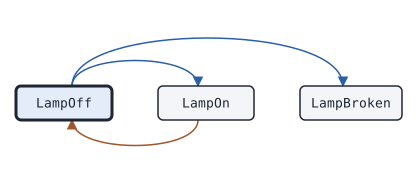
States of [`Lamp`](https://pkg.go.dev/github.com/USA-RedDragon/docgen/v2/machine#Lamp), from [`Lamp.State`](https://pkg.go.dev/github.com/USA-RedDragon/docgen/v2/machine#Lamp.State):
| State | Meaning | Seen in tests |
|---|---|---|
| [`LampOff`](https://pkg.go.dev/github.com/USA-RedDragon/docgen/v2/machine#LampOff) | LampOff gives no light. | yes, first state |
| [`LampOn`](https://pkg.go.dev/github.com/USA-RedDragon/docgen/v2/machine#LampOn) | LampOn gives light. | yes |
| [`LampBroken`](https://pkg.go.dev/github.com/USA-RedDragon/docgen/v2/machine#LampBroken) | LampBroken never gives light again. | yes |
Transitions seen in tests:
| From | Method call | To |
|---|---|---|
| LampOff | `Start` | LampOn |
| LampOff | `Break` | LampBroken |
| LampOn | `Stop`, `Tick` | LampOff |

<!-- /docgen:states -->Preview
The lamp
States of Lamp, from Lamp.State:
| State | Meaning | Seen in tests |
|---|---|---|
LampOff |
LampOff gives no light. | yes, first state |
LampOn |
LampOn gives light. | yes |
LampBroken |
LampBroken never gives light again. | yes |
Transitions seen in tests:
| From | Method call | To |
|---|---|---|
| LampOff | Start |
LampOn |
| LampOff | Break |
LampBroken |
| LampOn | Stop, Tick |
LampOff |
Some of the tests and another diagram path, with run= and diagram=§
v2/door/door.go
// Package door is a state machine with its own tests, for the run= argument.
package door
// State is the state of a Door.
type State uint8
// The State values.
const (
// StateClosed is shut.
StateClosed State = iota
// StateOpen is open.
StateOpen
)
// Door opens and closes.
type Door struct{ state State }
// State returns the state of the Door.
func (d *Door) State() State { return d.state }
// Open opens the Door.
func (d *Door) Open() { d.state = StateOpen }
// Close closes the Door.
func (d *Door) Close() { d.state = StateClosed }v2/door/door_test.go
func TestOpen(t *testing.T) {
var d Door
d.Open()
}docs/machines/guide-states-run.md
Before
<!-- docgen:states pkg=door type=Door run=TestOpen diagram=states/door-open.svg -->
<!-- /docgen:states -->After
<!-- docgen:states pkg=door type=Door run=TestOpen diagram=states/door-open.svg -->
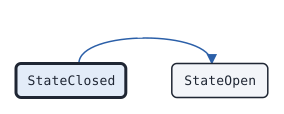
States of [`Door`](https://pkg.go.dev/github.com/USA-RedDragon/docgen/v2/door#Door), from [`Door.State`](https://pkg.go.dev/github.com/USA-RedDragon/docgen/v2/door#Door.State):
| State | Meaning | Seen in tests |
|---|---|---|
| [`StateClosed`](https://pkg.go.dev/github.com/USA-RedDragon/docgen/v2/door#StateClosed) | StateClosed is shut. | yes, first state |
| [`StateOpen`](https://pkg.go.dev/github.com/USA-RedDragon/docgen/v2/door#StateOpen) | StateOpen is open. | yes |
Transitions seen in tests:
| From | Method call | To |
|---|---|---|
| StateClosed | `Open` | StateOpen |

<!-- /docgen:states -->Preview
States of Door, from Door.State:
| State | Meaning | Seen in tests |
|---|---|---|
StateClosed |
StateClosed is shut. | yes, first state |
StateOpen |
StateOpen is open. | yes |
Transitions seen in tests:
| From | Method call | To |
|---|---|---|
| StateClosed | Open |
StateOpen |
docgen:doc§
A doc comment as Markdown: the package doc, or the doc of a type, func, method (Type.Method), const or var, or one # heading section of it.
docgen:doc pkg=<path> [name=<Name>] [section=<heading>]A pkg= that names a directory outside the module, such as a tool with a go.mod of its own, is the package doc of that directory. Its path is relative to the repository root. A name with no doc comment and a section= with no text are errors. Text in backticks in a doc comment is a code span.
The doc comment of one declaration, with name=§
v2/machine/machine.go
// Start turns the Lamp on. It returns ErrBusy while the Lamp is on.
func (l *Lamp) Start(now time.Duration) error {
    if l.state == LampOn {
        return ErrBusy
    }
    if l.state == LampOff {
        l.state, l.until = LampOn, now+l.wait
    }
    return nil
}docs/machines/guide-doc.md
Before
# Start
<!-- docgen:doc pkg=machine name=Lamp.Start -->
<!-- /docgen:doc -->After
# Start
<!-- docgen:doc pkg=machine name=Lamp.Start -->
Start turns the Lamp on. It returns ErrBusy while the Lamp is on.
<!-- /docgen:doc -->Preview
Start
Start turns the Lamp on. It returns ErrBusy while the Lamp is on.
A package doc, or one section of it, with section=§
v2/doc.go
// Package docgen is the fixture root package of the docgen tests.
package docgen
// ConfigError is the error of a constructor for a field with a value out
// of range.
type ConfigError struct{ Field string }
func (e *ConfigError) Error() string { return "bad " + e.Field }v2/machine/machine.go
// Package machine is a small state machine for the docgen tests.
//
// # Rates
//
// A Lamp blinks at these rates:
//   - slow, every [DefaultWait]
//   - fast, every period
//
// # Other
//
// Not copied.
package machinedocs/machines/guide-doc-package.md
Before
<!-- docgen:doc pkg=. -->
<!-- /docgen:doc -->

<!-- docgen:doc pkg=machine section=Rates -->
<!-- /docgen:doc -->
After
<!-- docgen:doc pkg=. -->
Package docgen is the fixture root package of the docgen tests.
<!-- /docgen:doc -->

<!-- docgen:doc pkg=machine section=Rates -->
A Lamp blinks at these rates:

  - slow, every [DefaultWait](https://pkg.go.dev/github.com/USA-RedDragon/docgen/v2/machine#DefaultWait)
  - fast, every period
<!-- /docgen:doc -->
Preview
Package docgen is the fixture root package of the docgen tests.
A Lamp blinks at these rates:
- slow, every DefaultWait
- fast, every period
docgen:gomod§
A line of the go.mod of the module, or of the go.mod at file=. It goes inline in a sentence.
docgen:gomod field=<go|toolchain|module> [file=<repo path>] [code=false]With code=false, the value has no backticks, as for docgen:const.
v2/go.mod
module github.com/USA-RedDragon/docgen/v2

go 1.24.0
cmd/tool/go.mod
module example.com/tool

go 1.24.0

toolchain go1.24.1
docs/machines/guide-gomod-lines.md
Before
- Module: <!-- docgen:gomod field=module --><!-- /docgen:gomod -->
- Go: <!-- docgen:gomod field=go --><!-- /docgen:gomod -->
- Module of the tool: <!-- docgen:gomod field=module file=cmd/tool/go.mod --><!-- /docgen:gomod -->
- Toolchain of the tool: <!-- docgen:gomod field=toolchain file=cmd/tool/go.mod --><!-- /docgen:gomod -->
After
- Module: <!-- docgen:gomod field=module -->`github.com/USA-RedDragon/docgen/v2`<!-- /docgen:gomod -->
- Go: <!-- docgen:gomod field=go -->`1.24.0`<!-- /docgen:gomod -->
- Module of the tool: <!-- docgen:gomod field=module file=cmd/tool/go.mod -->`example.com/tool`<!-- /docgen:gomod -->
- Toolchain of the tool: <!-- docgen:gomod field=toolchain file=cmd/tool/go.mod -->`go1.24.1`<!-- /docgen:gomod -->
Preview
- Module:
github.com/USA-RedDragon/docgen/v2 - Go:
1.24.0 - Module of the tool:
example.com/tool - Toolchain of the tool:
go1.24.1
A Go version with no backticks, with code=false§
v2/go.mod
module github.com/USA-RedDragon/docgen/v2

go 1.24.0
docs/machines/guide-gomod-code.md
Before
This module needs Go <!-- docgen:gomod field=go code=false --><!-- /docgen:gomod --> or later.After
This module needs Go <!-- docgen:gomod field=go code=false -->1.24.0<!-- /docgen:gomod --> or later.Preview
This module needs Go 1.24.0 or later.
docgen:usage§
The usage of a command.
docgen:usage cmd=<dir> [args="<args>"]docgen builds the command in that directory, relative to the repository root, and runs it with -h. With args=, the arguments are that value, split on spaces, such as args="help config" or args=--help. In the value, \" starts and ends an argument with spaces: args="--name \"a b\"".
A build failure, a panic, an exit status other than 0, 1 or 2, or output with no line that starts with usage, in any letter case, and no flag line, is an error. This also applies to arguments that do not ask for help, so a command such as version must print a usage line or a flag line, such as usage: tool version.
cmd/tool/main.go
func main() {
    n := flag.Int("n", 3, "how many lines to print")
    flag.Parse()
    for i := 0; i < *n; i++ {
        fmt.Println(i)
    }
}
docs/machines/guide-usage.md
Before
# Flags

<!-- docgen:usage cmd=cmd/tool -->
<!-- /docgen:usage -->
After
# Flags

<!-- docgen:usage cmd=cmd/tool -->
```text
Usage of tool:
  -n int
        how many lines to print (default 3)
```
<!-- /docgen:usage -->
Preview
Flags
Usage of tool:
  -n int
        how many lines to print (default 3)
The usage of a help command, with args=§
cmd/lamp/main.go
func main() {
    config := flag.NewFlagSet("lamp config", flag.ExitOnError)
    config.Duration("wait", 0, "the time before the lamp turns on")
    if len(os.Args) == 3 && os.Args[1] == "help" && os.Args[2] == "config" {
        config.SetOutput(os.Stdout)
        config.Usage()
        return
    }
    fmt.Println("usage: lamp <config|help> [arguments]")
}
docs/machines/guide-usage-args.md
Before
# The config command

<!-- docgen:usage cmd=cmd/lamp args="help config" -->
<!-- /docgen:usage -->
After
# The config command

<!-- docgen:usage cmd=cmd/lamp args="help config" -->
```text
Usage of lamp config:
  -wait duration
        the time before the lamp turns on
```
<!-- /docgen:usage -->
Preview
The config command
Usage of lamp config:
  -wait duration
the time before the lamp turns ondocgen:var§
The value of a variable of the vars setting, as a code span. It goes inline in a sentence.
docgen:var name=<key> [print=<go|raw|verb>] [code=false]A key that is not in vars is an error. The value is a string:
print=go, the default, andprint=raware the value as it is.print=%q, or any other fmt verb, is the string with that verb:"v1.2.3". A verb that a string cannot use, such as%d, is an error.print=nameis an error, since a value ofvarsis not a constant.- With
code=false, the value has no backticks, as fordocgen:const.
The boxes of docgen:var and docgen:text use this .docgen.yaml:
vars:
  version: v1.2.3
.docgen.yaml
vars:
  version: v1.2.3
docs/machines/guide-var.md
Before
The current version is <!-- docgen:var name=version --><!-- /docgen:var -->.After
The current version is <!-- docgen:var name=version -->`v1.2.3`<!-- /docgen:var -->.Preview
The current version is v1.2.3.
A quoted value, with print=%q§
.docgen.yaml
vars:
  version: v1.2.3
docs/machines/guide-var-print.md
Before
The quoted version is <!-- docgen:var name=version print=%q --><!-- /docgen:var -->.After
The quoted version is <!-- docgen:var name=version print=%q -->`"v1.2.3"`<!-- /docgen:var -->.Preview
The quoted version is "v1.2.3".
docgen:text§
Text from a template, in which vars values replace the keys. With no code=, the text goes inline in a sentence. With code=, it is a code block in that language, and code="text" is a block with no highlighting, so a value can go in a code block, where markers are text.
docgen:text text="<template>" [code=<language>]Here code= is a language. In docgen:const, docgen:var and docgen:gomod, code=false is the one value, for a value with no backticks.
The template has these forms:
{key}is the value of the variable. A key that is not invarsis an error.{{is a literal{.\nis a line ending, since an argument is one line.\\is a backslash, so\\nis a backslash and ann.
.docgen.yaml
vars:
  version: v1.2.3
docs/machines/guide-text.md
Before
<!-- docgen:text text="go install example.com/lamp@{version}\n# {{version} holds the version." code=sh -->
<!-- /docgen:text -->
After
<!-- docgen:text text="go install example.com/lamp@{version}\n# {{version} holds the version." code=sh -->
```sh
go install example.com/lamp@v1.2.3
# {version} holds the version.
```
<!-- /docgen:text -->
Preview
go install example.com/lamp@v1.2.3
# {version} holds the version.docgen:docgen§
A page of a sample directory, before and after an update.
docgen:docgen root=<dir> page=<path in root> [module=<dir>]docgen copies root to a temporary directory, runs update on the copy, and writes the page before and after it under the headings Before and After. page and module are relative to root. The update reads the .docgen.yaml of root for docs, print and vars, and uses the jobs, tags and depth of the outer run. The update always fills page, also outside docs. GOWORK applies only when its file is in root. Markers with one root and module use one copy and one update. An error of the update is an error of the marker, and a region that the update excerpts counts as used. Pages under root are not part of the outer run or its checks, unless root holds the page of the marker.
Each box of this page comes from a marker in this form. At the default depth this marker in a sample page is an error, so it has no box:
<!-- docgen:docgen root=internal/cli/testdata/repo module=v2 page=docs/machines/guide-const.md -->
<!-- /docgen:docgen -->
Marker rules§
- Arguments that hold spaces take double quotes:
section="Build tags". - In double quotes,
\"is a double quote, and any other backslash stays. - An optional argument with an empty value, such as
region="", is an error. - A
file=,cmd=,pkg=,root=ordiagram=value that leaves the repository is an error, also through a symlink. Symlinks inside the repository work, and a symlink in therootofdocgen:docgenmust stay in thatroot. - A generated file that leaves the repository through a symlink is an error, before any read or write.
- A comment in the form of a docgen tag that is not valid, in any letter case, is an error, and so is a close tag with no open tag.
- Marker text in a fenced code block or an inline code span is text, and so is
\<!--. An indented code block outside a marker is not text, so a marker shown that way is a real marker. - Generated text outside code shows the tag comments as
<!--. - The marks of a region can be in a page, as
docgen:regionanddocgen:endcomments. - CRLF line endings in a page stay.
- White space or > before a close tag stays, and the lines of the body get no prefix, so a block marker in a blockquote has its generated body outside the quote.
Source: docs/reference/markers.md